
Published on Ridetoai.com by Narendra Singh | Reading time: 12 minutes | Updated: June 2026
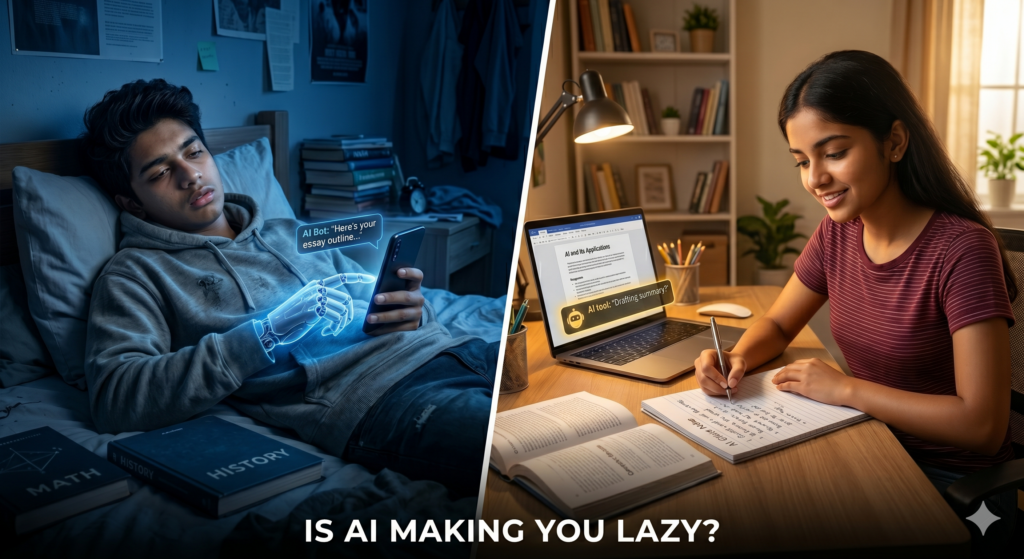
Picture this scene.
It is 11 p.m. A 16-year-old in Lucknow has a history assignment due tomorrow morning. Instead of opening the textbook, she opens ChatGPT on her phone, types the question, waits 8 seconds, and copies the answer directly into her notebook. Done. She closes her phone and goes to sleep, feeling like she has handled everything.
Now picture a different scene.
A 19-year-old in Pune is preparing for his semester exams the next morning. He has been using AI to “study” for two weeks. He opens his notes and realises he cannot explain a single concept in his own words. Everything he wrote came from AI. He understands none of it. The exam is in 12 hours.
Both of these students have something in common. They used AI. But only one of them actually learned anything.
This is the conversation India needs to have right now. Not about whether AI is good or bad — that debate is over. AI is here, it is powerful, and it is not going anywhere. The real conversation is about what happens to a young person’s mind when they let a machine do all their thinking for them.
This article does not take a side against technology. It tells you the truth about what science has found, what is really happening to students across India, and most importantly, what to do about it
Part One: The Real Problem — Understanding What AI Is Doing to Young Minds
It Starts Earlier Than You Think
The problem does not begin at 18 or 19. It starts much younger. Children as young as 10 and 11 years old are now using AI tools regularly — sometimes without their parents even knowing. They use it to do homework, to write answers in class projects, to generate creative writing, and even to prepare for tests.
At this age, between 10 and 13, the brain is in one of its most important developmental windows. This is the period when critical thinking, logical reasoning, and independent problem-solving are being built — not just learned, but physically wired into the brain through practice and effort.
When a 10-year-old types a question into an AI and copies the answer, that wiring does not happen. The brain gets the shortcut but misses the construction work that the shortcut was supposed to replace.
This is not a moral argument about laziness. It is a biological one. The brain develops through struggle. When struggle is removed too early, development slows.
The Teenage Years: Where the Damage Gets Serious
Between the ages of 13 and 18, students in India face enormous academic pressure. Board exams, competitive exam preparation, project submissions, and assessments pile up from every direction. AI appears at exactly this moment as a magical solution — an infinitely patient helper that never gets tired, never judges, and always produces an answer.
The temptation is completely understandable. When you are 15 years old, stressed about your boards, and AI can write your essay in 30 seconds, saying no to that shortcut requires a level of discipline that most adults would struggle with.
But here is what research has found about what actually happens during these years.
A major scientific study published in the National Library of Medicine found that AI significantly impacts human decision-making ability and promotes intellectual dependency in students. The study collected detailed data from hundreds of university students and found clear, measurable patterns — the more students used AI to generate answers rather than to understand concepts, the weaker their own reasoning abilities became over time.
Another comprehensive research review in the journal Smart Learning Environments (2024) found something even more concerning: that over-reliance on AI tools can negatively affect cognitive development — meaning the actual growth of a student’s thinking capacity — in ways that are difficult to reverse later. The researchers described the mechanism clearly: when a student repeatedly outsources thinking to a machine, the brain’s own problem-solving circuits receive less and less stimulation. Over time, they become less capable of working independently.
Think of it like this. If you always take the lift instead of the stairs, your leg muscles weaken. If you always use GPS, your natural sense of direction fades. If you always ask AI to think for you, your thinking weakens. The body and brain both follow the same basic rule: what you do not use, you lose.
The Indian Student’s Specific Reality
India is not a uniform country. A student in South Delhi and a student in rural Jharkhand live in completely different realities — different schools, different resources, different pressures, and different relationships with technology.
But both face a version of the same AI problem.
The student with full access — a good smartphone, fast internet, and daily AI usage — faces the risk of dependency. They have so much AI available that they stop practising independent thinking because it always feels unnecessary when the shortcut is right there.
The student with limited access — a shared phone, slow data, patchy connectivity — faces a different version. When AI is available to them, they often rely on it completely because they have had fewer opportunities to build confidence in their own thinking. The dependency forms faster because the foundation was already fragile.
Researchers who studied students specifically from Delhi-NCR in India found measurable effects of AI virtual assistants on both productivity and what they termed “intellectual laziness” — a pattern where students progressively reduced their own mental effort because they knew AI would cover the gap.
The city versus small-town divide also creates an unequal playing field that most people are not talking about. Urban students with consistent AI access can produce polished-looking assignments regardless of their actual understanding. Rural students without the same access are judged on raw understanding. The AI does not level the playing field — in many cases, it tilts it further.
The Exam Hall Moment of Truth
This is where everything becomes visible.
A student who has been using AI for every assignment for six months can produce excellent-looking work consistently. Their teacher is impressed. Their parents are satisfied. The marks look good.
Then the exam arrives. No phone allowed. No AI allowed. Just them, a pen, and their own mind.
Teachers across India — from private schools in Mumbai to government colleges in Bihar — are increasingly reporting the same phenomenon. Students who perform well in coursework, projects, and assignments are failing dramatically in unsupervised examinations. The gap between their coursework performance and their exam performance has never been wider.
This is not a coincidence. It is the direct result of outsourced thinking catching up with a student at the worst possible moment.
Part Two: What Science Calls This Problem — And Why It Should Worry Every Parent
The Term You Need to Know: Cognitive Offloading
Scientists use the term cognitive offloading to describe what happens when a person moves a mental task from inside their brain to an external tool.
Some cognitive offloading is completely fine and even smart. Writing a shopping list instead of memorising it. Using a calculator for complex arithmetic. Setting a phone reminder instead of trying to remember an appointment. These are healthy uses of tools to free up your brain for more important things.
The problem begins when cognitive offloading becomes a habit for tasks that are specifically meant to develop your brain.
Writing an essay is not just about producing an essay. It is about developing the ability to organise thoughts, argue a position, use evidence, and communicate ideas. When AI writes the essay instead, the essay gets produced — but none of that development happens.
A 2025 study published in ScienceDirect described this precisely: when students repeatedly externalise cognitive tasks to AI systems, it reduces their internal cognitive demands but simultaneously compromises deeper cognitive processes — the ability to infer meaning, synthesise information from multiple sources, and evaluate arguments critically. The study used the term “cognitive laziness” to describe the long-term pattern that develops, and noted that these higher-order thinking skills are exactly what employers, universities, and life itself will demand from these students.
The Confidence Collapse
There is another consequence that receives almost no attention: what AI dependency does to a young person’s self-confidence.
When a student never does anything difficult without AI assistance, they never discover what they are capable of. They never experience the satisfaction of solving a hard problem through their own effort. They never build the internal knowledge that says, “I can figure things out on my own.”
Research from 2025 found that students who were heavily reliant on AI as an authority figure experienced reduced academic engagement and noticeably lower self-confidence over time. They became more anxious, not less, about their own abilities — because deep down, they knew that their results were not truly theirs.
This is perhaps the most painful consequence of AI misuse in education. It is not just that students learn less. It is that they stop believing in themselves.
The Critical Thinking Crisis
In 2025, researchers at a major academic institution found that new research suggests overreliance on AI could hinder critical thinking in measurable and lasting ways. This is not just about schoolwork. Critical thinking is the foundation of every good decision a person makes in their life — in relationships, careers, finances, and citizenship.
A generation of young Indians who cannot think critically is not just an education problem. It is a national problem.
Part Three: The Solution for Students — How to Use AI Without Losing Your Mind
This section is written directly for students. If you are between 10 and 25 and reading this, this part is for you.
The One Question That Changes Everything
Before you use AI for any academic task, ask yourself this single question:
“Am I using this to understand something better, or am I using this to avoid thinking?”
If the honest answer is the second one, stop. Close the AI. Try the task yourself first even if you do it badly. Even if it takes longer. Even if you get it wrong, the attempt itself is the point — not the result.
The Five-Minute Rule That Actually Works
Here is a simple rule that any student can follow, regardless of age or subject.
Before opening any AI tool for a homework task or problem, spend at least five minutes working on it completely alone. Write down what you already know. Attempt the question even if you are unsure. Make mistakes on paper.
After five minutes, if you are genuinely stuck, then open AI — but not to copy an answer. Open it to ask for an explanation. “Can you explain this concept to me?” is a good question to ask AI. “Write my answer for me” is not.
The five-minute rule keeps your brain in the driver’s seat, with AI as a navigator rather than a replacement driver.
How to Use AI as a Tutor, Not a Typist
This is the most important mental shift any student can make.
A tutor helps you understand things better. A typist produces output for you. AI can be an extraordinary tutor. It becomes destructive when you use it as a typist.
Here is the practical difference in how you use it:
Using AI as a tutor looks like this: You read a chapter on photosynthesis, but do not fully understand it. You ask AI: “Can you explain photosynthesis in simple language and give me a real-life example I can picture?” AI explains it. You close AI. You write a summary in your own words without looking at what AI said. You compare your summary to the explanation. You notice the gaps. You learn.
Using AI as a typist looks like this: You have an assignment on photosynthesis due tomorrow. You type “Write a 200-word answer on photosynthesis.” You copy the result. You submit it. You learned nothing. In three weeks, when your teacher asks you a question about photosynthesis in front of the class, you have nothing.
The output is the same in both scenarios. The learning is completely different.
The “Teach It Back” Method
This is one of the most powerful study techniques that scientists have ever validated, and AI makes it even more effective.
After using AI to learn something, try to explain it back — out loud or in writing — as if you are teaching it to a friend who knows nothing about the topic. If you can explain it clearly and simply, you have understood it. If you cannot, you did not — regardless of how good the AI-generated notes looked.
You can even use AI itself for this. Tell it: “I am going to try to explain this concept to you. Please tell me where my explanation is wrong or incomplete.” Then explain the concept in your own words. AI will correct you. You will learn far more from that interaction than you ever would from simply copying an answer.
What Students at Different Ages Should Focus On
Ages 10 to 13 — Build Curiosity, Not Dependence
At this age, the most important thing is to stay curious. Use AI to explore questions that textbooks do not fully answer. “Why does the sky look different colours at sunset?” “How does a vaccine teach the body to fight a disease?” “What would happen if gravity were twice as strong?” Let AI fuel your curiosity — but always try to explain the answers back in your own words. Never let AI do the work that is supposed to be done by your developing brain. This age group especially should be closely guided by parents, because the habits formed between 10 and 13 tend to last a long time.
Ages 14 to 17 — The Pressure Years — Stay in the Driver’s Seat
These are the years when academic pressure peaks and AI temptation is the strongest. The board exam pressure, the project deadlines, the assignments — all of it creates a perfect storm for AI dependency to take root. The most important discipline during these years is to complete every first draft — of every essay, every answer, every project — entirely in your own words before touching AI. Use AI only to review, improve, and deepen what you already wrote. Never to replace the first attempt. These are also the years to start building things with AI — simple projects, creative experiments, small tools. This transforms your relationship with AI from dependent to creative.
Ages 18 to 25 — Build a Portfolio, Not Just a Resume
At this age, most students are in college or just entering the workforce. The risk here is slightly different. AI dependency at college level does not just affect learning — it affects your ability to perform in job interviews, presentations, group discussions, and any situation where your own thinking is visible. Employers in India are increasingly aware that AI can produce polished written work. What they are now testing in interviews is raw thinking — the ability to reason, adapt, and communicate under pressure without preparation. If you have been outsourcing your thinking to AI for two years, that interview moment will expose it. The students who will thrive at this age are those who use AI to build real things — websites, apps, content, projects, analysis — that demonstrate their own capabilities using AI as a tool, not a crutch.
Part Four: A Detailed Guide for Parents — What to Do and What to Avoid
This section is written for every parent in India. You do not need to know what ChatGPT is. You do not need to understand how algorithms work. What you need to understand is your child — and this section will help you have the right conversations.
The Worst Thing You Can Do: Ban AI Completely
Many parents, when they first learn about AI in education, want to ban it from the house. This feels like the safest response. It is actually one of the most damaging ones.
India’s government has already made AI a compulsory part of school education starting in 2026. The government, CBSE, and IIT Madras are working together to make AI literacy a core skill alongside mathematics and English. The future your child is being prepared for is one where AI is a daily professional tool — as common as email or spreadsheets are today.
Banning AI at home does not protect your child from it. It just means they encounter it without guidance, without context, and without the healthy habits they need to use it well. Children who are not taught to use AI responsibly will not avoid it — they will just use it unsupervised and carelessly.
The Right Approach: Supervised Engagement
Think of AI the way you think of other powerful tools that require parental guidance — the internet, social media, even driving a vehicle. The goal is not to keep your child away from the tool. The goal is to make sure they learn to use it safely, wisely, and in a way that serves them rather than harming them.
This requires conversation, not control alone.
Conversations That Actually Help
You do not need to be a technology expert to have these conversations. You just need to be a present and curious parent.
When your child comes home from school, ask: “What did you learn today — not what did you do, not what marks did you get, but what do you actually understand better than you did this morning?”
This question is more powerful than it sounds. It shifts the focus from output to understanding. A child who has been using AI to produce work without learning will struggle to answer it honestly. A child who has genuinely learned something will be excited to tell you.
When your child is doing homework, ask: “Can you explain to me what this question is asking?” “What do you think the answer might be, even if you are not sure?” “Did you try it yourself before asking AI?”
These questions do not require you to know the subject. They just require you to be present and to ask.
When your child shows you a project or assignment, ask: “Tell me about this in your own words.” “What was the hardest part to understand?” “What would you do differently if you did this again?”
If your child cannot answer these questions — if they look at their own submitted work and struggle to explain it — that is important information. It means the work was produced, not learned.
Simple Rules That Any Family Can Follow
You do not need software or parental control apps to manage this well. Simple household agreements, clearly communicated and consistently kept, work better than any filter.
Rule One — The Attempt First Rule. AI is only allowed after your child has genuinely attempted the work on their own. Not just opened the book and looked at it for 30 seconds. A real attempt — written notes, thinking time, some kind of independent effort. This rule alone prevents the most destructive form of AI dependency.
Rule Two — The Explanation Test. Before submitting any work that involved AI, your child should be able to sit with you for five minutes and explain what they learned. If they cannot explain it, they cannot submit it as their own work. This is not punishment — it is the actual standard of learning.
Rule Three — No AI During Practice Tests. Whenever your child is doing mock exams, past papers, or practice questions in preparation for any test, AI must be completely unavailable. The exam environment needs to be practised. You cannot practise for a no-AI exam by using AI.
Rule Four — Build Something, Do Not Just Use. Encourage your child to use AI to create something — a short story, a simple website, a science experiment design, a video script — at least occasionally. Building with AI develops a completely different relationship with the technology than consuming from it.
Rule Five — Talk About AI Mistakes. AI makes mistakes. It sometimes produces wrong information confidently. Make it a family habit to occasionally catch an AI error together. Ask your child “do you think this is accurate? How would we check?” This builds healthy scepticism and critical evaluation — exactly the mindset they need.
What Good AI Use at Home Looks Like
Here is a real picture of healthy, productive AI use for a student at home:
A 15-year-old is struggling to understand a concept from their geography lesson. They have read the textbook twice and still feel confused. They open an AI tool and type: “Can you explain how monsoon winds work in India? I understand that they come from the ocean but I do not understand why they bring rain.”
AI explains it with an analogy. The student reads it, thinks about it, and then closes the AI. They take out a blank sheet of paper and try to draw the monsoon wind pattern from memory and write an explanation in their own words. They compare their explanation to what AI said. They see what they got right and what they missed. They fill in the gaps.
The next morning, when their teacher asks a question about monsoon patterns, this student raises their hand.
That is what AI-assisted learning looks like when it is working correctly.
Free Tools That Help Indian Parents Monitor Responsibly
You do not need to spend money or become a technology expert to help your child use AI safely.
Google Family Link is a completely free app from Google that works on Android phones. It lets you see which apps your child is using, how long they spend on each app, and set daily time limits. It works on Jio, Airtel, and VI networks without any additional cost. If your child is under 18 and uses an Android device, this is worth setting up.
Screen Time settings on iPhone work similarly for Apple device users and are built directly into the phone’s settings with no app needed.
The most effective tool of all costs nothing. Keep screens visible in common family areas during study time. A child who studies in a shared living space where a parent can glance at the screen naturally develops healthier habits than one who studies alone in a room with a closed door. This is not surveillance — it is the same reason libraries have open floor plans.
Part Five: How AI Can Help Your Child Build Things — The Exciting Part
Everything so far has focused on the risks. Now for the part that should make every parent and student feel hopeful.
Because when AI is used correctly — with curiosity, with effort, with real engagement — it genuinely transforms what a young person is capable of creating. Not just learning. Actually building.
The Difference Between Users and Creators
There is a fundamental difference between a child who uses AI and a child who creates with AI.
A user asks AI to do things for them. A creator uses AI to do things they could not do alone. The world is going to increasingly reward the second category and increasingly automate the tasks of the first.
Here is what Indian young people are already building with AI — not consuming, but creating:
A 17-year-old in Tamil Nadu used AI tools to build a WhatsApp chatbot in Tamil that helps local farmers understand crop disease symptoms. No professional programming knowledge was required. He described what he wanted to build in plain English, and AI helped him build it step by step. Local farmers now use it.
A 20-year-old college student in Pune who had never written a line of code used a platform called Replit — which allows you to describe software in plain language — to build a study schedule app designed specifically for students preparing for competitive exams. She is now getting users.
A group of 14 and 15-year-olds in a government school in Rajasthan used AI to create educational videos in Hindi explaining science concepts that their textbooks made confusing. They posted them online. Other students from rural areas started watching them.
These are not exceptional genius children with special resources. They are ordinary students who decided to use AI as a creation tool rather than a shortcut tool.
What Children Between 10 and 13 Can Build Right Now
Children in this age group are often more comfortable with technology than their parents. They learn fast, adapt quickly, and are genuinely curious about how things work. This is the perfect age to channel that curiosity into creation rather than just consumption.
At this age, children can use AI to design simple things — a poster for a school event, a short story with original characters, a quiz for their classmates on a topic they know well, a model explanation of a science concept in their own language. They can use AI to generate ideas and then execute those ideas themselves.
The goal at this age is not to produce impressive outputs. The goal is to experience the creative loop — idea, attempt, feedback, improvement — with AI as a collaborator. This builds creative confidence that will serve them their entire lives.
Parents should sit with their child during these creative sessions at this age. Not to supervise them strictly, but to be genuinely curious together. “Oh, that is interesting — why did you ask it that way?” “What do you think it will say if you change the question?” This kind of shared exploration is healthy, bonding, and educational for both parent and child.
What Teenagers Between 14 and 19 Can Build
This age group has the energy, the ideas, and increasingly the technical capability to build things that matter. With AI, the barrier between an idea and a working prototype has collapsed dramatically.
A teenage student today can:
Build a basic website for a family business, a local NGO, or a personal project — without any professional web development knowledge — using AI-assisted platforms and clear instructions.
Create a YouTube or Instagram channel about a topic they genuinely know and care about, using AI to help with scripts, descriptions, and content planning — while providing the actual knowledge, personality, and perspective themselves.
Design a solution to a local community problem — a noise complaint tracker for a neighbourhood, a homework help group organised through a chatbot, a local event calendar — using free AI tools and basic platform skills.
Develop a personal project portfolio that demonstrates real capability. In a world where employers are becoming increasingly sceptical of AI-generated work, a portfolio of things you genuinely built using AI as a tool — rather than just AI-generated essays — stands out dramatically.
The critical thing at this age is that the idea, the design decision, and the purpose must come from the student. AI provides the execution support. The student provides the thinking.
What Young Adults Between 20 and 25 Can Build
At this age, AI becomes a genuine career accelerator when used as a building tool. The combination of domain knowledge — whatever your field of study — and AI capability is more powerful than either alone.
A 22-year-old studying digital marketing can use AI to run actual campaigns for small local businesses, track real results, and build a portfolio of proven outcomes. This kind of portfolio is worth more than any degree in the current Indian job market.
A 24-year-old who loves writing can use AI to produce, edit, and distribute content at a scale that would have required a full team five years ago — and build a genuine audience in the process.
A young person interested in any technical field can use AI coding assistants to build functional applications, automate tasks, and solve real problems — even without a formal computer science background.
The young adults who are going to thrive in the next ten years in India are not the ones who knew the most or had the best marks. They are the ones who learned how to work effectively alongside AI while maintaining the human judgement, creativity, and ethical reasoning that AI cannot replace.
Part Six: The AI Future — What Every Indian Young Person Needs to Understand
The World Your Child Is Entering
By the time a 12-year-old today enters the workforce, AI will be as standard a workplace tool as email or Microsoft Office is today. The question will not be “do you use AI?” Everyone will. The question will be “how well do you use AI, and what can you do that AI cannot do alone?”
The skills that will be most valuable — and most rare — in that world are exactly the skills that AI dependency destroys: independent critical thinking, creative problem-solving, communication, emotional intelligence, ethical judgement, and the ability to learn new things quickly.
This is not a paradox. AI is becoming more powerful at the same time that deeply human skills are becoming more valuable. The reason is simple: as AI handles more routine thinking tasks, the tasks that remain for humans become increasingly those that require genuine human intelligence — context, judgement, originality, and connection.
AI Literacy Is Now a Life Skill
The Indian government’s decision to make AI a compulsory subject from 2026 onwards reflects this reality. AI literacy — the ability to understand what AI is, how it works, what its limitations are, and how to use it responsibly — is no longer optional. It is a basic life skill for this generation, in the same category as reading, mathematics, and financial literacy.
AI literacy does not mean knowing how to code AI systems. It means:
Understanding that AI can be wrong — and knowing how to check. Understanding that AI reflects the biases and errors in the data it was trained on. Knowing how to write a good prompt that gets useful results. Knowing when to use AI and when not to. Being able to evaluate AI-generated content critically rather than accepting it automatically. Understanding the basic privacy and ethical considerations of using AI tools.
A child who develops these abilities between the ages of 10 and 18 will enter adulthood with a genuine advantage over peers who either avoided AI out of fear or used it mindlessly as a shortcut.
The Mindset That Separates Winners From Losers in the AI Age
This is the most important thing in this entire article, so read it slowly.
AI is a mirror. It reflects what you bring to it.
If you bring laziness — the desire to produce output without doing work — it gives you that. And over time, it takes away your ability to do the work yourself. You end up with polished-looking output and a weakened mind.
If you bring curiosity — the desire to understand things better, to explore, to question, to build — it amplifies that. You end up understanding things more deeply than any student in history has been able to, with more resources, more explanations, and more creative tools than any previous generation had access to.
The students who will win in the AI age are not the smartest or the most privileged. They are the ones who maintain the discipline to keep thinking — who use AI to go further, not to avoid going at all.
That discipline is a choice. It can be made at 10. It can be made at 17. It can be made at 24. It is never too late to decide that your own mind is worth developing.
The Conclusion: A Message to Every Student Reading This
You are growing up at one of the most interesting moments in human history.
The tools available to you are more powerful than anything any previous generation of students ever had. A child in a small town in Chhattisgarh with a basic smartphone today has access to more information, more explanation, more tutoring, and more creative tools than students at the best universities in the world had twenty years ago.
That is extraordinary. Do not waste it by using all that power to avoid thinking.
Use it to understand things so deeply that you become the person who can explain them to others. Use it to build things that solve real problems in your community. Use it to ask questions that your textbooks do not answer. Use it to develop skills that make you genuinely capable, not just capable of producing outputs.
Your brain is the most powerful technology in the room. AI is a tool to help it go further. Never let the tool replace the person using it.
Frequently Asked Questions
Q: Is it wrong to use AI for homework? Using AI to better understand a topic and then writing your own response is good studying. Copying AI-generated text and submitting it as your own work is academic dishonesty. The honest question to ask yourself is: could you explain what you submitted in your own words if your teacher asked you to?
Q: At what age should children start using AI tools? There is no single right answer because children develop differently. What matters more than age is context and supervision. Children between 10 and 13 should use AI only with parental awareness and guidance. Teenagers between 14 and 18 can use AI more independently but benefit strongly from clear household rules about how and when it is appropriate. The focus at every age should be on using AI to understand and create, not to produce work without understanding.
Q: Which AI tools are safe and appropriate for students in India? Google Gemini’s free version is well-suited for Indian students — it supports Hindi, works without any VPN, has real-time information access, and integrates with Google tools that students already use. Khan Academy’s AI tutor called Khanmigo is designed specifically for learning and never just gives answers — it guides students to find answers themselves. Both are free and accessible in India.
Q: My teenager uses AI for everything. Is it too late to change the habit? It is never too late. Habits formed around technology change when the context changes — when there is a clear reason, clear rules, and clear guidance. Start with one simple change: the attempt-first rule. Before any AI is used for any academic task, your teenager must spend at least five minutes working on it independently. Introduce this one rule consistently and other healthy habits follow more naturally.
Q: Will AI replace the jobs my child is studying for? Some jobs will change significantly. Routine tasks in many fields are being automated. But research from the World Economic Forum consistently shows that AI creates as many new roles as it displaces — and the roles it creates require exactly the human skills that education is supposed to develop: critical thinking, communication, creativity, ethical judgement, and the ability to learn continuously. The students who will be most secure in their careers are those who develop these human skills deeply while also learning to work effectively with AI tools.
Q: How can I tell if my child has developed an unhealthy AI dependency? Ask your child to explain something from their recent homework or project in their own words — without looking at any notes or screen. If they can explain it clearly and answer follow-up questions about it, their learning is intact. If they look blank or cannot explain what they themselves submitted, that is a clear signal that AI has been replacing their thinking rather than supporting it. This is a useful test to run regularly and without warning.
Key Research Referenced in This Article
- National Library of Medicine (2023) — Study on AI’s impact on decision-making and intellectual laziness in students
- Smart Learning Environments Journal (2024) — Systematic review of AI dialogue systems and cognitive development
- ScienceDirect (2025) — Research on cognitive offloading, AI dependency, and critical thinking decline
- Delhi-NCR Student Study (2025) — Research specifically examining AI virtual assistants and student productivity in India
- UNICRI AI Literacy for Children Project (2025) — Parent guidance framework developed with UNICEF and Harvard University
- World Economic Forum Future of Jobs Report (2025) — Data on AI’s impact on employment and the rise of human-skill premium
- India Ministry of Education AI Curriculum Announcement (2025-26) — Compulsory AI education rollout information
This article is published on RideToAI.com — India’s trusted source for AI tools, news, and guidance for everyday Indian readers. If this article helped you, share it with a parent, teacher, or student who needs to read it. The conversation matters.