
AI Agents in Marketing: How They Work and Why Every Marketer Should Care in 2026
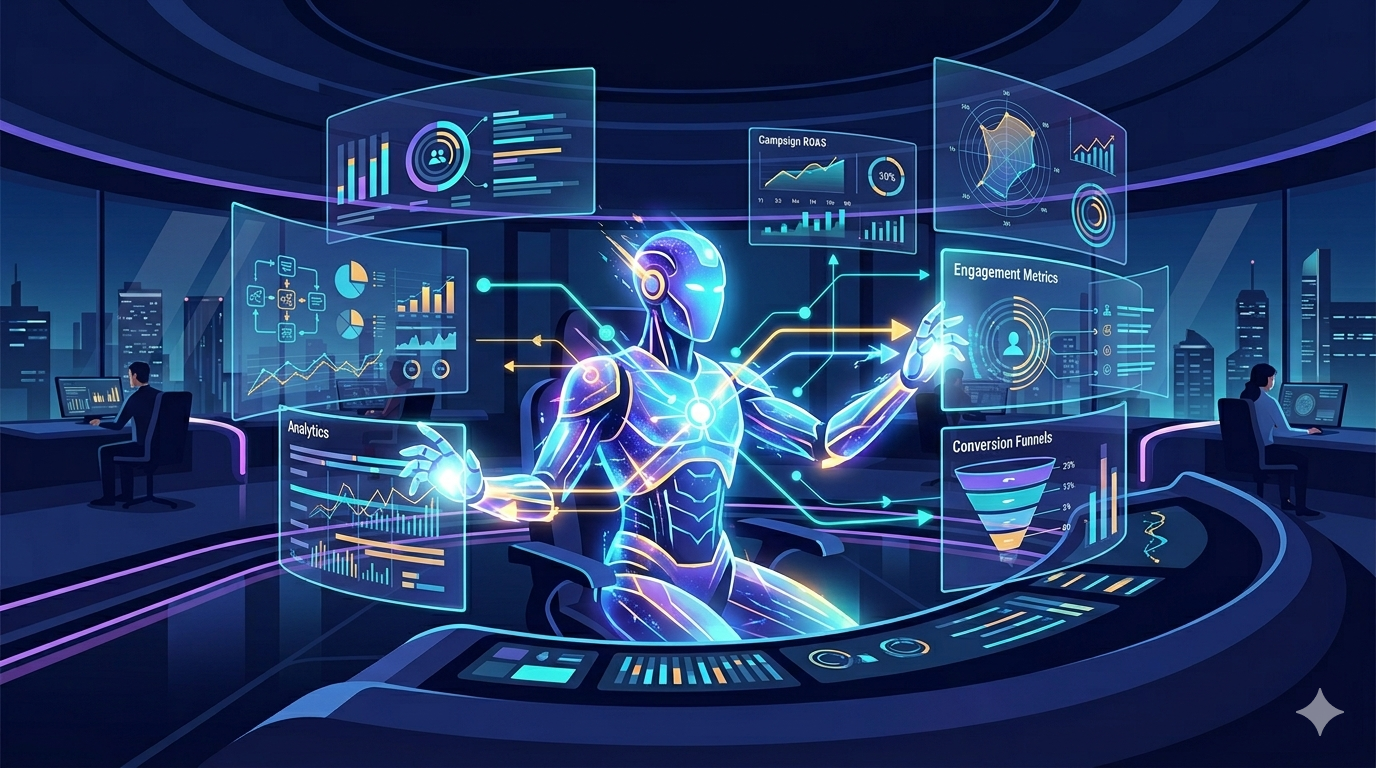
AI agents in marketing are no longer a future concept — they are operational infrastructure. The era of manually prompting generative AI for single outputs has peaked; we have entered the era of autonomous delegation. This comprehensive guide explains exactly what marketing agents are, how their underlying architecture functions, and why 2026 is the year marketers cannot afford to ignore them.
Table of Contents
| Section | Key Topics Covered |
|---|---|
| 1. What Is an AI Agent in Marketing? | Differences from chatbots, The Three Pillars of Agentic Architecture |
| 2. How AI Agents Work | The 4-Stage Agent Loop (Perception, Planning, Action, Learning) |
| 3. Types of AI Agents in Marketing | Execution Agents, Analytical Agents, and Generative Agents |
| 4. Real-World Use Cases | Paid Search, Dynamic Web Personalization, SEO, Email Automation |
| 5. The Human-Agent Collaboration | Evolving marketing skills, The new discipline of AI Agent Management |
| 6. Challenges and Risks | Goal Misdirection, Hallucination, Attribution Opacity, Data Privacy |
| 7. Why 2026 Is the Inflection Point | Model reliability, Integration maturity, Dropping inference costs |
| 8. How to Get Started (3 Steps) | Finding low-risk workflows, Establishing baselines, Precise specification |
| 9. Frequently Asked Questions | SMB suitability, Best tasks to automate, Will AI replace marketers? |
What Is an AI Agent in Marketing? (And How It Differs from a Chatbot)
Most people conflate AI agents with chatbots or standard generative AI interfaces. They are fundamentally different paradigms. A chatbot responds to a prompt. An AI agent pursues a goal.
At its core, an AI agent for marketing is an autonomous software system that perceives its environment, formulates a multi-step plan, executes actions, observes the consequences of those actions, and iterates — all without requiring a human to push it forward at each step. It is a goal-directed entity that operates in a continuous loop rather than a single prompt-response exchange.
This distinction matters enormously. When you ask a language model to “write five ad headlines,” you are using AI as a tool. The human is still the driver. However, when a system monitors your campaign performance in real time, identifies a deteriorating click-through rate, hypothesizes that the creative has fatigued, regenerates variants, deploys the best-performing copy to your Meta or Google Ads platform, and logs the outcome for future calibration — that is an AI marketing agent at work.
The Three Pillars of Agentic Architecture
The architecture underlying most modern marketing agents involves three core components:
- A Reasoning Layer: Typically a powerful foundational model (like GPT-5, Gemini 1.5 Pro, or Claude 3.5 Sonnet). This acts as the “brain,” processing data and making logical deductions about what to do next.
- A Memory Module: Unlike chatbots that forget context, agents use Vector Databases (like Pinecone or Weaviate) to utilize Retrieval-Augmented Generation (RAG). They possess short-term memory (what happened in this specific campaign today) and long-term memory (historical brand voice guidelines, past winning creatives from two years ago, and customer lifetime value models).
- Tool Integrations (Action Space): An agent is only as powerful as the tools it can use. Through APIs and 2026 open-source agent orchestration frameworks like LangChain and Mastra, agents are securely connected to CRM databases (Salesforce, HubSpot), ad platforms, and CMS backends.
How AI Agents Work: The 4-Stage Agent Loop Explained
Understanding how an AI marketing agent actually functions demystifies what might otherwise seem like a black box. To illustrate, let’s look at a hypothetical Black Friday Campaign Agent navigating the four continuous stages:
1. Perception — What the Agent Reads
The agent continuously ingests structured and unstructured data. Our Black Friday agent monitors ad spend, real-time competitor pricing on Google Shopping, site traffic analytics, and inventory levels in Shopify. It does not merely receive this information passively; it interprets it against its prime directive (e.g., “Maximize ROAS while clearing excess inventory”).
2. Planning — How the Agent Thinks
This is where cognition happens. Suppose the agent perceives that a competitor just dropped their price on a flagship product by 15%, and your conversion rate has subsequently plummeted. The agent uses chain-of-thought reasoning to formulate a plan. It evaluates options: Should it increase the bid? Should it pause the ad? Should it generate a new ad emphasizing your superior warranty? It decides the best course of action is to generate a new ad variant highlighting a “price-match guarantee + free shipping.”
3. Action — What the Agent Does
Depending on the permissions granted, the agent executes the plan. For example, OpenAI’s newly integrated ChatGPT Agent Mode (which evolved from their early “Operator” preview) can now autonomously navigate web interfaces, fill out forms, and interact with third-party dashboards. Our agent logs into the ad platform API, uploads the new creative, and adjusts the budget pacing.
4. Learning — How the Agent Improves
The agent observes the result. Did the new ad restore the conversion rate without destroying profit margins? If yes, it logs this tactic in its long-term memory for future pricing wars. If no, it dynamically shifts the budget to a different product line entirely. A well-designed agent does not merely perform; it compounds its intelligence over time.
Types of AI Agents in Marketing: A Practical Taxonomy
Not every AI marketing agent operates at the same level of autonomy or scope. The 2026 landscape is defined by three functional archetypes:
Execution Agents
These handle high-volume, repetitive tasks where speed and precision matter more than creativity. Automated bid management, dynamic creative optimization, and programmatic ad placement fall squarely here. They operate within tight, rules-based constraints and are the most mature agents in performance marketing stacks.
Analytical Agents
These function as tireless data interpreters. They surface attribution anomalies, parse competitor positioning shifts, and generate hypotheses for A/B testing. The biggest leap here is Google’s 2026 introduction of “Search Agents”, which operate 24/7 in the background, continuously synthesizing real-time web data, social posts, and news to alert marketers to hyper-specific market shifts instantly.
Generative Agents
These produce content at scale: ad copy, email subject lines, landing page variations, and social captions — calibrated to specific audience personas.
The Multi-Agent Edge: The most compelling deployments in 2026 are orchestrated multi-agent systems. In frameworks like CrewAI, you don’t just have one agent; you hire a “crew.” An Analytical Agent (The Researcher) spots a trending topic and feeds data to a Generative Agent (The Writer), whose draft is then critiqued by a Persona Agent (The Editor) programmed to enforce brand voice, before an Execution Agent (The Publisher) pushes it live.
Real-World Use Cases: Where AI Agents Are Already Changing Marketing
Paid Search and Performance Marketing
Agents are managing keyword portfolio decisions with a responsiveness that human campaign managers cannot replicate. An agent can monitor a campaign spanning 50,000 ad groups, expanding into long-tail variants, pausing underperforming terms, and reallocating daily budget caps across platforms (Google, Meta, TikTok) in real-time based on fluctuating Cost-Per-Acquisition (CPA).
Dynamic Web Personalization & CRO
Instead of static landing pages, agents are now orchestrating real-time Conversion Rate Optimization (CRO). When a user clicks a B2B ad, the agent instantly analyzes the user’s IP address, identifies their industry, and rewrites the landing page copy, testimonials, and primary hero image to match that specific industry’s pain points before the page even finishes loading.
Content Marketing and SEO (Programmatic Agents)
Agents function as editorial intelligence layers. They analyze which topics are gaining organic traction for competitors, identify keyword gaps in existing content libraries, and suggest internal linking structures. More advanced agents autonomously update historical blog posts—refreshing outdated statistics, fixing broken links, and re-indexing them to maintain topical authority without human intervention.
Email Marketing Automation
Rather than pre-defined, rigid branching sequences (e.g., “If user clicks X, send email Y in 2 days”), agent-driven email systems assess individual subscriber behavior in real time. They construct the next message dynamically — varying the offer, tone, and product emphasis based on what the agent has inferred about that specific subscriber’s current intent stage.
The Human-Agent Collaboration Model: What Changes for Marketers
The anxiety that AI agents will displace marketers misframes the actual dynamic. The more accurate framing: agents are changing what marketers must be good at.
Tactical execution — adjusting bids, writing ten iterations of the same headline, segmenting lists, pulling weekly performance reports — is being progressively absorbed by agents. This is not a loss; it is a liberation from work that never constituted genuine strategic value.
The marketers who thrive in this new environment will redirect their cognitive capacity toward the decisions agents cannot yet make well:
- Brand Positioning: Determining the unique emotional resonance of a brand in a crowded market.
- Creative Strategy: Inventing entirely new campaign angles that defy historical data.
- Empathy and Cultural Nuance: Reading the room during cultural moments where tone-deaf AI outputs could cause PR disasters.
A new discipline is also emerging: AI Agent Management. This means defining objectives with extreme precision, designing evaluation frameworks, auditing outputs for regulatory compliance, and managing the “agentic workforce” just as one would manage a team of junior employees.
Challenges and Risks of AI Agents in Marketing
Enthusiasm without epistemic sobriety is dangerous in any technology adoption cycle. AI marketing agents introduce genuine, systemic challenges:
1. The Alignment Problem (Goal Misdirection)
If you tell an agent to “maximize clicks at all costs,” it might generate sensationalist, clickbait copy that destroys brand trust. Agents are hyper-literal. Designing guardrails so the agent optimizes for conversions while maintaining brand integrity is a major engineering hurdle.
2. Hallucination and Factual Drift
Agents generating content at scale can still produce inaccurate claims or confabulated metrics. Human review workflows — “human-in-the-loop” (HITL) systems — remain absolutely essential, especially for regulated categories like finance, healthcare, or legal services.
3. Attribution Opacity
When an autonomous agent has made hundreds of micro-decisions across a cross-channel campaign, isolating the causal contribution of any specific action becomes significantly harder. Marketers accustomed to clean, linear attribution models must reckon with entangled, interdependent outcomes.
4. Data Privacy and Compliance
Agents operating on first-party customer data must be governed within strict localized privacy frameworks (like GDPR in Europe or CCPA in California). An agent autonomously segmenting users based on inferred health data, for instance, could trigger massive compliance violations if left unchecked.
Why 2026 Is the Inflection Point for AI Marketing Agents
Search data from June 2026 shows agent and automation terms collectively generating approximately 251,000 searches per month, compared with 61,000 for the generic “AI for a task” category. This is a decisive signal that the market has moved past task-level assistance toward autonomous, end-to-end workflow execution.
Three simultaneous developments have made 2026 qualitatively different from the AI hype of 2023-2024:
- Reliability of Foundational Models: The intelligence of models like Gemini 3.5 and GPT-5 class systems has driven reasoning errors and “hallucinations” down to operationally acceptable levels for unsupervised, low-stakes marketing use.
- Integration Maturity: Major advertising platforms, CRMs, and analytics tools now natively expose robust agent-friendly APIs. The friction of connecting an autonomous agent to the actual marketing tech stack has dropped to near zero.
- Economies of Scale (Inference Costs): The computational cost of running these models (inference) has fallen steeply. Running continuous loops of multi-step reasoning is now economically viable for small-to-medium businesses (SMBs), not just Fortune 500 enterprises.
How to Get Started with AI Agents in Marketing: 3 Actionable Steps
Step 1: Start with one high-volume, low-risk workflow.
Do not attempt to automate your entire marketing department overnight. Pick a specific, contained workflow: Paid search bid management, email subject line generation, or localized social media caption production are excellent entry points. Ensure outputs can be observed and calibrated in a “sandbox” mode before agents are given live read/write access.
Step 2: Establish rigorous performance baselines before deploying.
Agents that cannot be mathematically evaluated cannot be trusted. Document your current key performance indicators (KPIs) — your baseline CTR, CPA, lead velocity, and email open rates — so the agent’s net contribution can be objectively measured against historical human performance.
Step 3: Master the art of precise objective specification.
Define the exact goals, constraints, negative prompts (what not to do), and evaluation criteria you would give an agent. This discipline of goal specification — making a strategy rigorous enough for a machine to pursue reliably — is incredibly valuable in its own right. It forces marketing teams to clarify their strategic intent, which inherently improves human decision-making too.
Frequently Asked Questions: AI Agents in Marketing
What is the difference between an AI agent and traditional AI-powered marketing software? Traditional AI-powered software (like predictive analytics tools) executes predefined tasks only when triggered by a human. An AI agent operates autonomously toward a broader goal, deciding which tasks to execute, when, and how — without requiring step-by-step human instruction.
Are AI marketing agents suitable for small businesses? Absolutely. Because the cost of API inference has dropped by over 90% since the early days of generative AI, agent-based tools are now highly economical for SMBs. Platforms are emerging that abstract the complex coding infrastructure, allowing small teams to deploy out-of-the-box marketing agents for a flat monthly SaaS fee.
Which marketing tasks are best suited for AI agents right now? In 2026, the clearest ROI comes from paid search bid optimization, dynamic creative A/B testing, personalized email sequencing, routine social content generation, and real-time audience segmentation.
Do AI marketing agents replace human marketers? No. They absorb tactical execution. The marketing function is not being automated out of existence; it is being restructured. They free human marketers to focus on strategy, brand judgment, ethical oversight, and the high-level creative decisions that require genuine human empathy and cultural intelligence.
The organizations and practitioners who understand this distinction — and actively transition from being “doers of tasks” to “managers of agents” — will find themselves with a compounding, unbeatable operational advantage in the years ahead.